If you’re searching for the “best free antivirus,” you’ve likely felt that moment of panic: a suspicious link, a weird pop-up, or just general concern about your data. I’ve spent years testing mobile security software, and I’ll be honest—the advice you need depends entirely on whether you carry an Android or an iPhone.
In the United States, mobile security is a Your Money Your Life (YMYL) topic. Google’s algorithms look for high E-E-A-T (Experience, Expertise, Authoritativeness, and Trustworthiness) to ensure users aren’t being misled by “scareware” or fake cleaner apps.
This guide breaks down what actually works, what is marketing hype, and which apps are safe to install in 2026.
Do You Actually Need Antivirus on Mobile?
The answer is a definitive “Yes” for Android and a “No” for iPhone—but with some important context.
The Android Reality
Android’s open architecture allows apps to access broader system permissions, which is great for customization but means malware can theoretically hide in the background. A reputable antivirus app acts as a proactive shield, scanning downloads and flagging malicious behavior before you even open a file.
The iPhone Myth
iPhones use “sandboxing,” a security architecture where every app is isolated in its own container. An app literally cannot scan other apps or the system files for viruses because Apple doesn’t allow it. When you see “iPhone Antivirus” apps, they are actually security suites that provide VPNs, phishing protection, and data breach alerts—not virus scanners.
Best Free Antivirus for Android (USA)
For Android users, I recommend apps that prioritize real-time scanning and minimal battery impact. Avoid apps that promise to “boost speed” or “clean RAM”—these are often deceptive.
1. Bitdefender Antivirus Free
Bitdefender is my top pick for simplicity. It uses a “zero-configuration” approach, meaning it installs, runs, and protects you without needing constant manual adjustments. It relies on cloud-based scanning, so it won’t drain your battery.
-
Best for: Users who want “set it and forget it” protection.
-
Key Feature: Lightweight, automatic scanning of new apps.
2. Avast Mobile Security
Avast is feature-heavy and excellent for those who want more than just a virus scanner. Their free version includes a Wi-Fi security scanner (essential for public coffee shop networks) and an “App Lock” to secure sensitive apps like banking or photos with a PIN.
-
Best for: Privacy-conscious users.
-
Key Feature: Wi-Fi speed and security analysis.
3. Malwarebytes for Android
If you suspect your phone is already acting “weird,” Malwarebytes is the gold standard for cleaning. While it lacks some of the “suite” features of Avast, its engine is surgical when it comes to detecting and removing stubborn adware and spyware.
-
Best for: Remediation and cleaning infected devices.
-
Key Feature: Industry-leading malware detection engine.
Best Security Apps for iPhone (iOS)
Since you don’t need a virus scanner, look for apps that solve the actual threats: phishing, public Wi-Fi snooping, and data leaks.
1. Norton 360 (Mobile Security)
Norton is arguably the most authoritative name in consumer security. While the full suite is paid, their iOS app provides excellent SMS Spam Protection and Web Protection, which block you from visiting known phishing sites that try to steal your login credentials.
-
Best for: Comprehensive web and identity protection.
-
Key Feature: AI-powered scam protection for text messages.
2. Avira Security & Privacy
Avira is a fantastic “no-frills” option. It includes a free, limited VPN, which is a major plus for iPhone users who frequently connect to public Wi-Fi. It also provides a “Privacy Manager” that stops Siri from recording your interactions.
-
Best for: Secure browsing on public Wi-Fi.
-
Key Feature: Built-in free VPN and privacy tools.
3. TotalAV
TotalAV is user-friendly and includes a very helpful Data Breach Scanner. It checks if your email address or passwords have appeared in any major dark web leaks, allowing you to change them before your accounts are compromised.
-
Best for: Identity monitoring.
-
Key Feature: QR Code scanner that checks for malicious links.
How to Avoid Deceptive “Cleaner” Apps
In the app stores, you will find hundreds of apps with names like “Super Fast Cleaner” or “Antivirus Master.” Be extremely cautious.
According to Google’s Unwanted Software Policy, many of these are deceptive. They often:
-
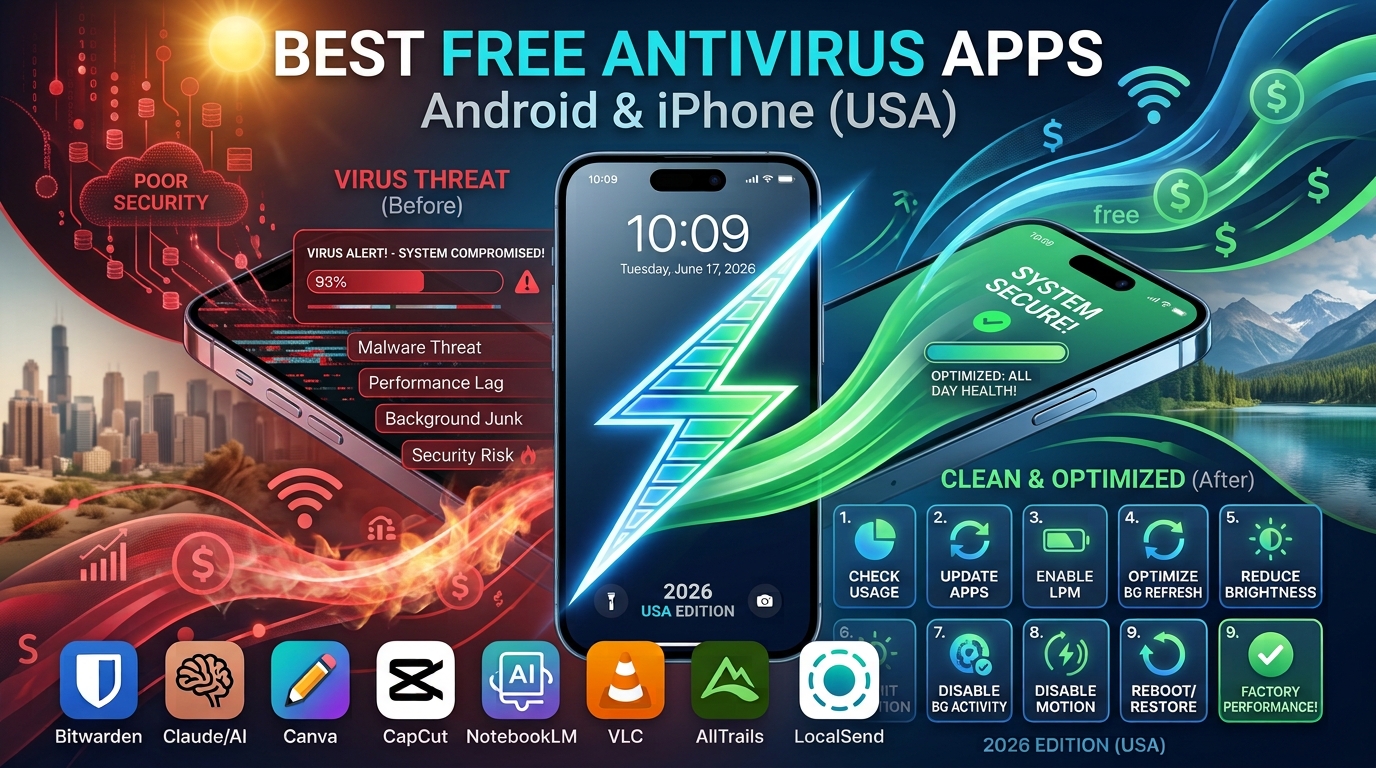
Display fake “System Infected” alerts to trick you into a subscription.
-
Overload the screen with intrusive ads.
-
Drain your battery by running constant, unnecessary “optimizations.”
Rule of Thumb: If an app claims to “double your battery life” or “fix 100 viruses instantly,” delete it. Real security is quiet, efficient, and transparent.
Expert Tips for Maximum Mobile Safety
Beyond installing an app, these habits provide 90% of your total security profile:
-
Keep Your OS Updated: Apple and Google patch “Zero-Day” vulnerabilities constantly. If you see an update notification, install it immediately.
-
Enable Stolen Device Protection (iPhone): Go to Settings > Face ID & Passcode to ensure your biometric security cannot be bypassed by someone who knows your passcode.
-
Use Google Play Protect (Android): It is built into your phone. Ensure it is turned on in the Play Store settings—it is your first line of defense against malicious apps.
-
Avoid Sideloading: Only download apps from the official Google Play Store or Apple App Store. “Cracked” APKs or non-official app stores are the #1 source of mobile malware.
Frequently Asked Questions (FAQs)
Are free antivirus apps safe?
Yes, if they are from reputable companies like Bitdefender, Avast, or Malwarebytes. These companies offer “Freemium” models—they provide great basic protection for free to build trust and hope you eventually upgrade for advanced features like unlimited VPNs.
Can my iPhone get a virus?
In the traditional sense of a self-replicating virus that jumps from phone to phone—no. However, your iPhone can be compromised through malicious configuration profiles, phishing links, or sketchy calendar invites.
Does a VPN act as an antivirus?
No. A VPN encrypts your internet traffic so hackers on public Wi-Fi cannot see your data. An antivirus checks your local files for malicious code. They are complementary, not interchangeable.
How do I know if my phone has been hacked?
Look for “red flag” behaviors: the battery drains rapidly while the phone is idle, the device runs extremely hot, you see unfamiliar apps you didn’t install, or you receive strange text messages from numbers you don’t recognize.
Is “System Data” on my iPhone a virus?
No. “System Data” consists of cache, logs, and temporary files that iOS manages. It is normal for this to fluctuate. If it grows too large, a simple restart of your iPhone usually clears out the temporary cache files.